
The Philippine BPO industry is one of the country’s biggest job creators. In 2024 alone, the sector added about 120,000 new jobs and brought in $38 billion in revenue. That kind of growth is impressive.
But growth comes with growing pains.
Behind the good numbers, many BPO teams are dealing with burnout, high turnover, and leaders who are still learning how to lead. These problems don’t show up in a quarterly report right away. Over time, though, they quietly chip away at performance, morale, and customer experience.
Many organizations have responded by investing in wellness programs, employee engagement activities, and leadership training. These efforts are valuable, but many companies continue to struggle with burnout, high turnover, absenteeism, and inconsistent leadership.
This raises an important question.
What helps employees and leaders perform well when the pressure doesn’t go away?
More organizations are finding that the answer goes beyond technical skills. Emotional intelligence, or EI, is becoming an important part of how leaders manage people, build trust, and create healthier workplaces.
In this article, we’ll look at why emotional intelligence matters in the BPO industry, what the research says, and how organizations can develop these skills to support both people and business performance.
The BPO Workforce Challenge Is Bigger Than Just Numbers
The Philippine BPO industry has built its reputation on speed, quality, and customer service. Performance metrics such as average handling time, customer satisfaction scores, first-call resolution, and quality assurance remain important measures of success.
But these numbers only tell part of the story.
Behind every customer interaction is an employee who may be dealing with long shifts, difficult conversations, changing schedules, and the pressure to meet daily targets.
Many BPO employees regularly experience:
- Emotional exhaustion after handling difficult customer interactions
- Workplace stress caused by demanding workloads
- Sleep disruption from night shifts and rotating schedules
- Burnout after long periods of pressure
- Customer-related conflict and escalations
- High expectations for speed, quality, and productivity
These challenges affect more than individual employees. They also influence how teams perform and how long people stay with the organization.
Many BPO companies continue to face issues such as:
- High employee attrition
- Frequent absenteeism
- Leadership readiness gaps
- Employee disengagement
- Workplace wellbeing concerns
These problems are often connected.
An employee who feels emotionally drained may become less engaged at work. Over time, that can lead to more absences, lower performance, or a decision to leave the company altogether. When experienced employees leave, managers spend more time recruiting, onboarding, and training replacements instead of helping their teams grow.
Attrition is a good example of how serious this is. Industry data shows contact centers can see attrition rates around 40%, while global in-house centers sit closer to 10-15%. That’s a huge difference, and it often comes down to how well people are supported and led, not just how much they’re paid.
So, the real challenge isn’t just about hitting performance targets anymore. It’s about building workplaces where people can perform well and stay well at the same time.
Why Leadership Matters More Than Ever
BPO leaders have one of the hardest people-management jobs around. On any given day, they need to:
- Hit performance targets
- Keep employees engaged
- Handle customer escalations
- Support employee wellbeing
- Lead hybrid or remote teams
- Adjust to constant operational changes
That’s a lot to carry.
In many organizations, frontline leaders are promoted because they were top-performing agents or specialists. Their technical knowledge and strong performance make them excellent candidates for promotion.
But leading people requires a different set of skills.
A high-performing employee does not automatically become an effective coach, communicator, or manager.
Many new leaders receive training on systems, processes, and performance management. Fewer receive practical development in skills such as:
- Coaching employees through challenges
- Giving constructive feedback
- Managing conflict
- Regulating their own emotions during stressful situations
- Building trust with their teams
These skills become especially important in high-pressure environments like contact centers and when leaders don’t have these skills, small problems turn into big ones. A missed coaching moment can turn into a resignation. An unmanaged conflict can turn into a toxic team. The quality of leadership often decides whether a challenge stays small or becomes a costly problem.
But it’s also important to remember: Leadership does not remove workplace challenges. But it often determines whether those challenges become manageable problems or reasons why employees choose to leave.
Emotional Intelligence: The Missing Capability in Many BPO Development Programs
Many BPO companies invest heavily in leadership development. Managers attend workshops, employees complete compliance training, and teams join engagement activities throughout the year.
These programs have value, but they do not always address the skills people need most when working with other people.
For example, a team leader may know how to read reports, monitor performance, and manage schedules. But what happens when an employee is showing signs of burnout? Or when a customer call becomes heated? Or when two team members disagree and the conflict starts affecting performance?
Technical knowledge alone cannot answer these situations.
Leaders also need the ability to stay calm, understand what others are feeling, communicate clearly, and make thoughtful decisions under pressure. These are all part of emotional intelligence.
According to psychologist Daniel Goleman, emotional intelligence includes skills such as self-awareness, self-management, social awareness, and relationship management. These skills help people work well with others and respond more effectively in challenging situations. Harvard Business Review has also highlighted emotional intelligence as an important part of effective leadership, especially in roles that require managing people and building strong relationships.
How Emotional Intelligence Supports Common BPO Challenges
Many of the challenges faced in the BPO industry have an emotional side. Employees may feel frustrated, anxious, overwhelmed, or discouraged. Leaders experience these emotions too.
Here’s how common BPO challenges connect to specific emotional intelligence skills:
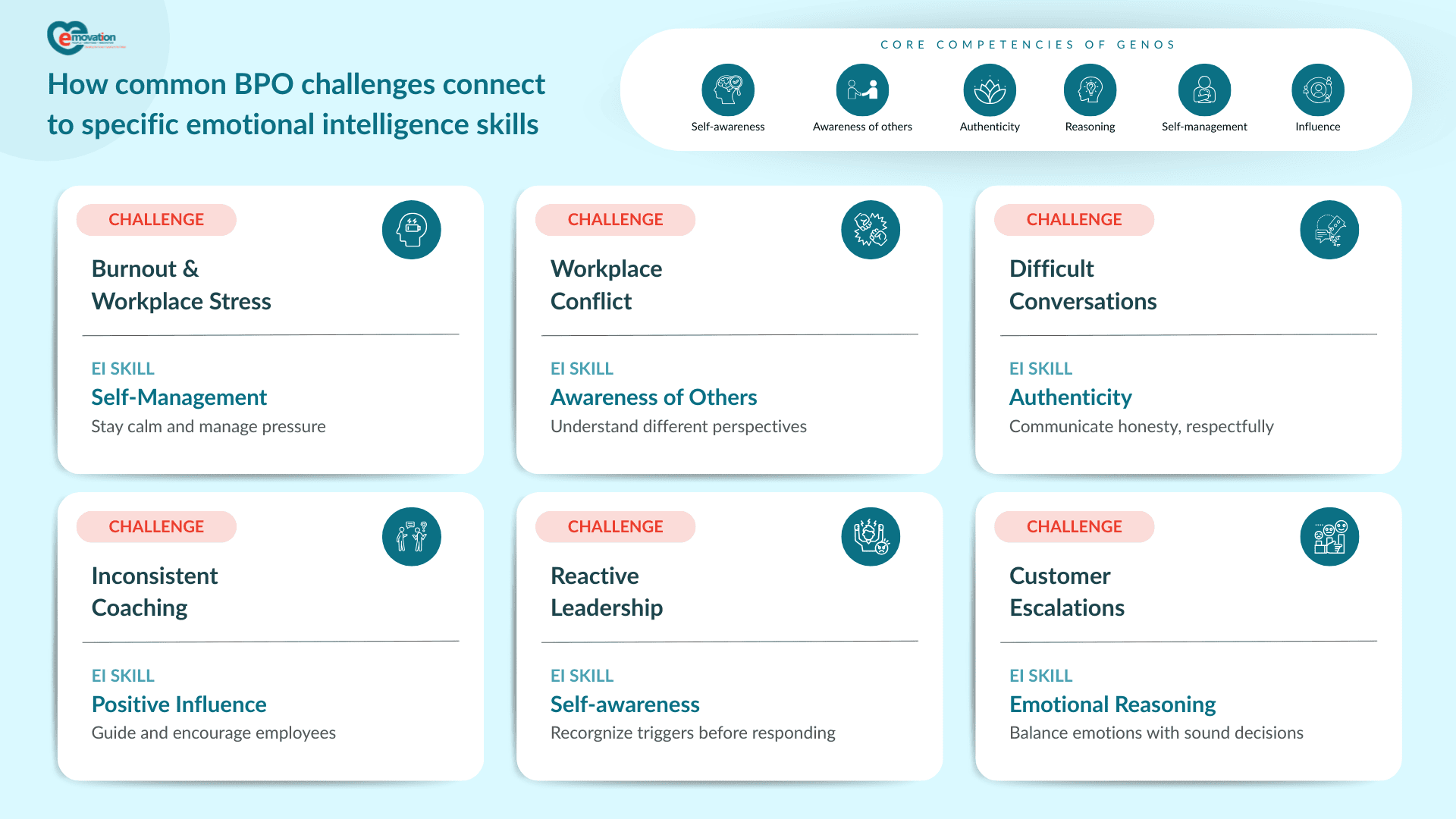
These skills do not remove workplace challenges. Difficult customers, busy seasons, and operational changes will always be part of the job.
What emotional intelligence changes is how people respond to those challenges.
For example, consider two supervisors handling the same situation.
An employee misses several performance targets after returning from a series of night shifts.
One supervisor immediately focuses on the numbers and issues a warning.
Another starts by asking what has changed, listens carefully, and works with the employee to create a plan for improvement while still holding them accountable.
Both leaders address the performance issue.
The difference is that one builds trust while solving the problem.
For BPO organizations, this is why emotional intelligence should not be viewed as a “soft skill.”
It is a practical workplace skill that helps leaders manage people, supports employees during stressful situations, and contributes to better experiences for both customers and teams.
As the demands of the industry continue to grow, developing emotional intelligence is becoming just as important as developing technical knowledge and operational expertise.
The Business Impact of Emotional Intelligence
Emotional intelligence is often seen as a people skill. But research shows that it also has a measurable impact on how teams perform, how leaders lead, and how organizations operate.
Here’s how it plays out across different parts of the organization.
Workforce Outcomes
- Better employee wellbeing
- Higher engagement
- Smoother onboarding experiences
- More psychological safety
- Stronger relationships between coworkers
Leadership Outcomes
- Better coaching conversations
- More effective leaders
- Stronger resilience under pressure
- More consistent performance reviews
- Better decision-making
Operational Outcomes
- Lower absenteeism
- Less turnover
- Better quality scores
- Higher productivity
- Fewer compliance issues
Customer Outcomes
- More empathy during calls and chats
- Better customer interactions
- Stronger overall customer experience
- Higher customer satisfaction scores
When you add these up, emotional intelligence touches nearly every metric a BPO organization already tracks.
Why Emotional Intelligence Must Be Measured
Most companies already track things like:
- Engagement
- Productivity
- Performance
- Retention
- Customer satisfaction
But very few measure:
- Emotional intelligence
- Leadership behavior
- Emotional culture
Here’s the problem with skipping this step. Without measurement, training becomes generic. Coaching has no clear direction. And behavior change is nearly impossible to sustain, because nobody can point to what actually needs to improve.
If you can’t measure it, it’s hard to grow it.
Moving Beyond One-Size-Fits-All Training
Leadership training often follows the same format for everyone. Managers attend the same workshops, complete the same activities, and are expected to apply what they have learned in their own way.
The challenge is that every leader has different strengths and development needs.
One manager may need help giving feedback. Another may struggle to manage emotions during difficult conversations. Someone else may find it challenging to build trust with a new team.
Without knowing where these gaps exist, development can become too broad to make a lasting difference.
By measuring emotional intelligence, organizations can:
- Identify individual strengths and development areas
- Give leaders more meaningful coaching
- Create learning plans based on real workplace behaviours
- Track progress over time
- Measure whether development efforts are leading to behavioural change
This allows learning and development teams to focus their resources where they are needed most.
How Genos Assessments Can Help
Genos Emotional Intelligence is designed specifically for the workplace.
Unlike personality assessments, which describe a person’s natural preferences or traits, Genos measures how often people demonstrate emotionally intelligent behaviours while they are at work.
This is an important distinction.
Personality is generally stable over time. Workplace behaviours, however, can be developed through coaching, feedback, and practice.
Genos measures six key emotional intelligence competencies:
- Self-Awareness – Recognizing your own emotions and understanding how they affect your behaviour.
- Awareness of Others – Noticing and understanding the emotions of the people around you.
- Authenticity – Communicating openly, honestly, and respectfully.
- Emotional Reasoning – Using emotions alongside facts when making decisions.
- Self-Management – Staying calm and managing emotions during challenging situations.
- Positive Influence – Encouraging, motivating, and influencing others in constructive ways.
Genos Solutions for BPO Teams
- Emotionally Intelligent Workplace Behavior Assessment – Measures how often employees show emotionally intelligent behavior at work
- Emotionally Intelligent Leadership Assessment – Gives leaders clear, practical feedback on where to grow
- Genos Selection Tool – Helps hiring teams spot candidates with strong emotional intelligence
- Emotional Culture Index (ECI) – Shows how employees currently feel, expect to feel, and want to feel at work
- Genos Grow – A digital learning platform for ongoing EI development across the whole workforce
Each of these tools gives BPO leaders something training alone can’t: real data on where people actually stand, and a clear path forward.
Building Stronger, Healthier BPO Teams
Technology and process improvements will always matter in the BPO industry. But they’re not what will decide who wins long-term. That comes down to people, and how well organizations attract, develop, and hold on to good ones.
Change keeps speeding up. Employee expectations keep rising. Workplaces keep getting more complex. In that kind of environment, emotional intelligence isn’t optional anymore. It’s a core business skill.
Companies that take EI seriously tend to see stronger employee wellbeing, better retention, sharper customer experience, and more consistent performance overall. On top of this, the Philippine Mental Health Act (RA 11036) already requires employers to have a mental health policy in place, so investing in wellbeing isn’t just good practice. It’s also the law.
Assessment results are only one part of the picture.
Real change happens when organizations combine measurement with learning, coaching, and wellbeing support.
Through its emotional intelligence programs, leadership development workshops, and ElevateMinds mental health services, Emovation helps organizations create workplaces where employees can develop the skills they need to manage pressure, communicate effectively, and build stronger working relationships.
For BPO organizations, this means investing not only in performance, but also in the people who make that performance possible.









Leave A Comment